
Description
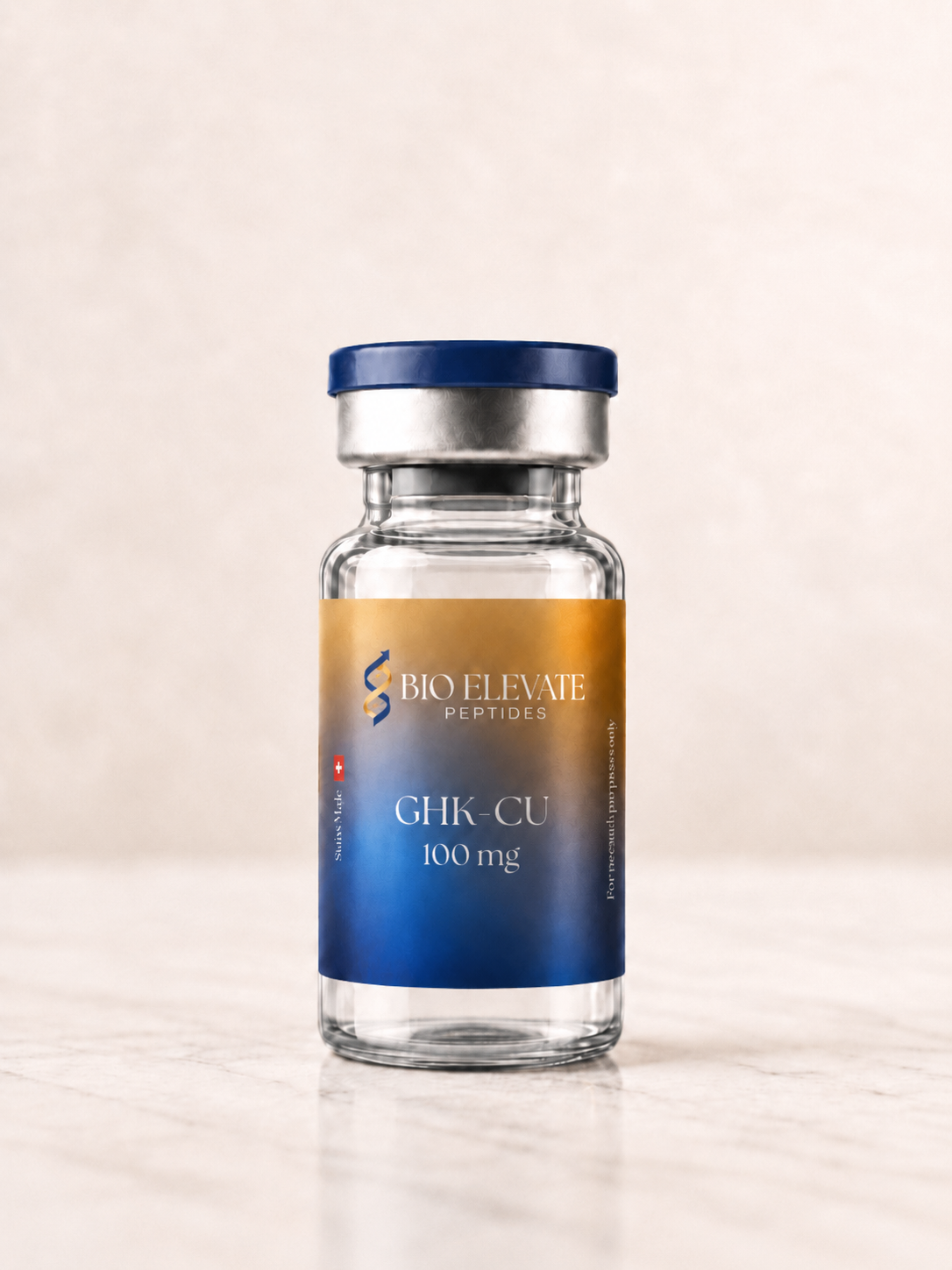
GHK-Cu | 100mg Research Grade · Swiss Manufactured · Lyophilized
Overview
GHK-Cu (Glycyl-L-Histidyl-L-Lysine Copper(II)) is a naturally occurring human plasma tripeptide with an extraordinarily high affinity for copper(II) ions, forming a stable 1:1 coordination complex that constitutes its biologically active form. First isolated from human plasma albumin in 1973 by Dr. Loren Pickart, GHK-Cu has since evolved from a curiosity of plasma biochemistry into one of the most comprehensively studied and mechanistically diverse peptides in modern biomedical research. Endogenously present in human plasma, saliva, and urine, circulating GHK-Cu levels decline significantly with age — from approximately 200 ng/mL at age 20 to under 80 ng/mL by age 60 — a trajectory that has drawn intense scientific interest given its broad regulatory roles across wound healing, tissue remodeling, antioxidant defense, anti-inflammatory signaling, and gene expression regulation. What renders GHK-Cu uniquely compelling in the peptide research landscape is the sheer breadth and mechanistic depth of its biological activity: genome-wide expression analyses have identified GHK-Cu as capable of modulating the expression of over 4,000 human genes, resetting dysregulated gene expression patterns in aged or damaged tissue toward profiles characteristic of younger, healthier biological states. This capacity for large-scale transcriptional reprogramming, combined with its exceptional safety profile and remarkable versatility across tissue types, has established GHK-Cu as a foundational research tool in regenerative biology, dermatology, oncology, neuroscience, and geroscience.
Sequence & Coordination Chemistry
Gly-His-Lys · Cu²⁺
Molecular Formula: C₁₄H₂₄CuN₆O₄ Molecular Weight: 403.92 g/mol CAS Number: 89030-95-5 Appearance: Blue lyophilized powder (characteristic copper coordination complex coloration) Purity: ≥ 99% (HPLC verified) Copper Coordination: Square planar Cu(II) complex via His imidazole nitrogen, Gly α-amino nitrogen, deprotonated Gly-His peptide bond nitrogen, and His-Lys peptide bond nitrogen
Copper Coordination & Structural Significance
The copper(II) coordination complex is not incidental to GHK-Cu’s biology — it is constitutive to its mechanism:
| Coordination Site | Residue | Role |
|---|---|---|
| α-Amino nitrogen | Gly N-terminus | Primary coordination anchor |
| Deprotonated amide nitrogen | Gly-His peptide bond | Square planar geometry contributor |
| Imidazole nitrogen | His side chain | High-affinity Cu²⁺ chelation |
| Amide nitrogen | His-Lys peptide bond | Complex stabilization |
- The resulting square planar Cu(II) complex exhibits exceptional stability across physiological pH ranges
- GHK’s copper affinity (Ka ~10¹⁷) exceeds that of albumin, enabling it to efficiently acquire and deliver copper to copper-dependent enzymes including lysyl oxidase, superoxide dismutase (Cu/Zn-SOD), and cytochrome c oxidase
- Copper delivery to these enzymes is a key mechanism underlying GHK-Cu’s effects on collagen crosslinking, antioxidant defense, and mitochondrial respiratory function
- The intact copper complex is required for full biological activity; the apo-peptide (GHK without copper) retains partial but reduced potency across most studied endpoints
Mechanism of Action
GHK-Cu operates through one of the broadest and most mechanistically sophisticated action profiles of any peptide under active research investigation:
Gene Expression Reprogramming
- Landmark genome-wide studies by Pickart and Margolina utilizing Broad Institute Connectivity Map data identified GHK-Cu as capable of modulating the expression of 4,062 human genes — 1,600+ upregulated and 2,400+ downregulated
- Gene sets activated include those governing tissue repair, antioxidant defense, mitochondrial function, anti-inflammatory signaling, and stem cell activation
- Gene sets suppressed include those associated with inflammation, oncogenic signaling, oxidative stress, and tissue destructive pathways
- Critically, GHK-Cu reverses the gene expression signature of COPD lung tissue toward that of healthy lung — one of the most striking demonstrations of its transcriptional reprogramming capacity
Collagen & Extracellular Matrix Regulation
- GHK-Cu simultaneously stimulates collagen synthesis (Types I, III, and IV) via fibroblast activation while activating matrix metalloproteinases (MMPs) for degradation of damaged, cross-linked collagen
- This dual regulation produces a net effect of ECM remodeling — replacing structurally compromised matrix with newly synthesized, architecturally sound collagen — rather than simple accumulation
- Stimulates synthesis of elastin, fibronectin, proteoglycans, and decorin, comprehensively restoring connective tissue architecture
- Activates lysyl oxidase (a copper-dependent enzyme) for proper collagen and elastin crosslinking, directly contributing to tissue tensile strength and elastic recoil
Angiogenesis & Wound Healing
- Potent stimulator of VEGF expression and angiogenic sprouting, driving neovascularization and blood supply restoration to hypoxic or damaged tissue
- Accelerates wound healing through coordinated stimulation of fibroblast proliferation, keratinocyte migration, endothelial cell activation, and inflammatory resolution
- Demonstrated activity in chronic wound models including diabetic ulcers and pressure wounds — contexts where normal repair mechanisms are significantly impaired
Antioxidant Defense
- Delivers bioavailable copper to Cu/Zn superoxide dismutase (SOD1), directly enhancing enzymatic superoxide radical neutralization capacity
- Upregulates expression of antioxidant response genes including catalase, glutathione S-transferase, and components of the thioredoxin system
- Chelation of free copper prevents participation of unbound Cu²⁺ in Fenton-type reactions that generate highly reactive hydroxyl radicals — paradoxically making copper delivery and copper sequestration simultaneous protective mechanisms
Anti-Inflammatory Signaling
- Inhibits TNF-α, IL-1β, IL-6, and TGF-β1 production across multiple cell types and tissue models
- Downregulates NF-κB pathway activation — the master transcriptional regulator of the inflammatory response
- Suppresses production of oxidized lipids and pro-inflammatory eicosanoids
- Promotes resolution-phase inflammation biology — transitioning tissue from active inflammatory to repair and remodeling states
Stem Cell & Progenitor Cell Activation
- Stimulates activation and recruitment of tissue-resident stem cells including dermal stem cells and hair follicle progenitor cells
- Upregulates expression of stem cell maintenance genes and growth factor receptors in aged tissue models
- This stem cell activation mechanism is considered central to GHK-Cu’s hair follicle biology and tissue rejuvenation research applications
Nervous System & Neuroprotection
- Promotes nerve growth factor (NGF) synthesis and neurotrophic signaling
- Demonstrates neuroprotective activity in oxidative stress and excitotoxicity models
- Stimulates neuronal branching and synaptic remodeling in culture models
- Anti-anxiety and cognitive effects have been explored in animal models via modulation of GABA receptor expression
Research Applications
GHK-Cu’s extraordinary breadth of biological activity generates a research profile that spans more organ systems and disease domains than virtually any other peptide of comparable size:
Dermatology & Skin Biology Research
- Skin aging models — age-related collagen loss, elasticity decline, and barrier function impairment
- Wound healing — acute and chronic wound models, scar formation and remodeling studies
- Fibroblast biology — proliferation, migration, collagen synthesis, and senescence research
- Keratinocyte function, epidermal differentiation, and barrier integrity studies
- Photoaging models — UV-induced collagen degradation and oxidative damage repair
- Melanogenesis regulation and pigmentation studies
Hair Follicle Biology Research
- Hair follicle cycling — anagen induction, catagen delay, and telogen efflux studies
- Dermal papilla cell activation and hair growth regulatory pathway research
- Androgenetic alopecia models — DHT-mediated follicle miniaturization and GHK-Cu counteraction studies
- Stem cell niche regulation in the hair follicle bulge region
Pulmonary & Respiratory Research
- COPD models — one of GHK-Cu’s most compelling research areas; gene expression studies have demonstrated near-complete reversal of COPD-associated transcriptional dysregulation
- Lung fibrosis models — TGF-β1 mediated fibroblast activation and ECM remodeling
- Oxidative lung injury — bleomycin and cigarette smoke exposure models
- Bronchial epithelial repair and airway remodeling research
Oncology Research
- Metastasis suppression — GHK-Cu has demonstrated capacity to suppress expression of genes associated with aggressive metastatic phenotypes in cancer cell line studies
- Reversal of oncogenic gene expression signatures in multiple tumor type models
- DNA repair pathway upregulation and genomic stability research in cancer models
- Differentiation pathway restoration in de-differentiated cancer cell models
Neurological Research
- Neuroprotection models — oxidative stress, excitotoxicity, and ischemic injury
- Neurotrophic factor regulation — NGF, BDNF, and NT-3 expression studies
- Peripheral nerve regeneration and remyelination models
- Neuroinflammation pathway modulation research
- Cognitive aging models and synaptic plasticity studies
Cardiovascular Research
- Vascular smooth muscle and endothelial cell biology
- Atherosclerosis models — oxidative modification of LDL and endothelial dysfunction
- Cardiac fibrosis and remodeling pathway studies
- Angiogenesis and collateral vessel development research
Aging & Geroscience
- Age-related gene expression dysregulation and transcriptional reprogramming research
- Cellular senescence reversal and senescence-associated secretory phenotype (SASP) modulation
- Tissue rejuvenation and functional restoration in aged animal models
- Multi-tissue aging biology — skin, lung, liver, muscle, and neurological aging models
- Longevity pathway interactions — mTOR, SIRT1, and FOXO axis modulation
Gastrointestinal Research
- Intestinal mucosal repair and barrier integrity studies
- Gastric ulcer healing models
- Inflammatory bowel disease — mucosal inflammation and remodeling research
Genome-Wide Expression Profile — Key Gene Regulation Highlights
| Biological Process | Direction | Key Genes Regulated |
|---|---|---|
| Collagen synthesis & ECM remodeling | ⬆️ Upregulated | COL1A1, COL3A1, MMP1, MMP2, TIMP1 |
| Antioxidant defense | ⬆️ Upregulated | SOD1, CAT, GPX1, TXNRD1 |
| Angiogenesis | ⬆️ Upregulated | VEGFA, FGF2, ANGPT1, HIF1A |
| Neurotrophic signaling | ⬆️ Upregulated | NGF, BDNF, NTRK1 |
| Stem cell activation | ⬆️ Upregulated | NOTCH1, WNT5A, LGR5 |
| Pro-inflammatory cytokines | ⬇️ Downregulated | TNF, IL1B, IL6, CXCL8 |
| Oncogenic signaling | ⬇️ Downregulated | MYC, RAS, VEGFC metastatic |
| Tissue destructive enzymes | ⬇️ Downregulated | MMP9, ELANE, CTSG |
| TGF-β fibrotic pathway | ⬇️ Downregulated | TGFB1, SMAD3, CTGF |
Comparative Profile — Regenerative & Anti-Aging Peptide Class
| Property | GHK-Cu | BPC-157 | TB-500 | Epithalon |
|---|---|---|---|---|
| Gene Expression Breadth | ⭐⭐⭐⭐⭐ | ⭐⭐⭐ | ⭐⭐⭐ | ⭐⭐⭐ |
| Collagen / ECM Remodeling | ⭐⭐⭐⭐⭐ | ⭐⭐⭐⭐ | ⭐⭐⭐⭐ | ⭐⭐ |
| Wound Healing | ⭐⭐⭐⭐⭐ | ⭐⭐⭐⭐⭐ | ⭐⭐⭐⭐ | ⭐⭐ |
| Antioxidant Activity | ⭐⭐⭐⭐⭐ | ⭐⭐⭐ | ⭐⭐⭐ | ⭐⭐⭐⭐ |
| Pulmonary Research | ⭐⭐⭐⭐⭐ | ⭐⭐ | ⭐⭐ | ⭐⭐ |
| Hair Follicle Biology | ⭐⭐⭐⭐⭐ | ❌ | ⭐⭐ | ❌ |
| Telomere / Longevity Biology | ⭐⭐⭐ | ❌ | ❌ | ⭐⭐⭐⭐⭐ |
| Neuroprotection | ⭐⭐⭐⭐ | ⭐⭐⭐⭐ | ⭐⭐ | ⭐⭐⭐ |
| Oncology Research Activity | ⭐⭐⭐⭐⭐ | ⭐⭐ | ❌ | ⭐⭐⭐ |
| Research Publication Volume | ⭐⭐⭐⭐⭐ | ⭐⭐⭐⭐⭐ | ⭐⭐⭐⭐ | ⭐⭐⭐⭐⭐ |
Quality & Manufacturing
BioElevate GHK-Cu is synthesized in our Swiss GMP-compliant facility using solid-phase peptide synthesis (SPPS) with Fmoc chemistry, followed by controlled copper(II) complexation under precisely managed pH and stoichiometric conditions to ensure complete, correctly coordinated Cu²⁺ incorporation. The characteristic blue coloration of the lyophilized product is verified as a quality indicator of successful copper coordination. Every batch undergoes comprehensive independent quality verification:
- Reverse-phase HPLC — purity ≥ 99% confirmed
- High-resolution mass spectrometry (HRMS) — full molecular weight confirmation including copper coordination
- ICP-MS (Inductively Coupled Plasma Mass Spectrometry) — copper content quantification and stoichiometric verification
- UV-Vis spectroscopy — copper complex integrity and coordination geometry confirmation
- Endotoxin testing — LAL method, endotoxin-free certification
- Sterility testing — USP <71> compliant
- Amino acid analysis (AAA) — compositional sequence verification
- Certificate of Analysis (CoA) — issued per batch, available upon request
Supplied As
- 100mg lyophilized powder per vial
- Characteristic blue lyophilized cake confirming intact copper coordination complex
- Sealed under inert nitrogen atmosphere to prevent oxidation
- Recommended storage: −20°C, protected from light and moisture
- Shelf life: 24 months (lyophilized); 30 days (reconstituted at 4°C)
- Large format vial designed to support high-volume, extended, and multi-experiment research protocols
Reconstitution
Reconstitute with sterile bacteriostatic water or sterile saline. GHK-Cu demonstrates excellent aqueous solubility — the reconstituted solution will display a characteristic pale blue coloration confirming intact copper complex integrity. For the 100mg vial, introduce solvent slowly along the inner vial wall in incremental additions, gently swirling between each addition until the lyophilized cake is fully dissolved. Do not vortex or shake vigorously. Allow the vial to equilibrate to room temperature prior to use. Once reconstituted, store at 4°C protected from light and use within 30 days. Aliquoting into smaller working volumes prior to storage is strongly recommended to avoid repeated freeze-thaw cycles. Avoid strongly alkaline pH conditions during reconstitution and handling, as pH above 8.5 may alter copper coordination geometry and reduce biological activity.
⚠️ For Research Use Only. This product is intended solely for in vitro and laboratory research purposes. Not for human or veterinary use. Not for consumption. BioElevate products are sold exclusively to licensed research institutions and qualified professionals.
Reviews
There are no reviews yet.