
Description
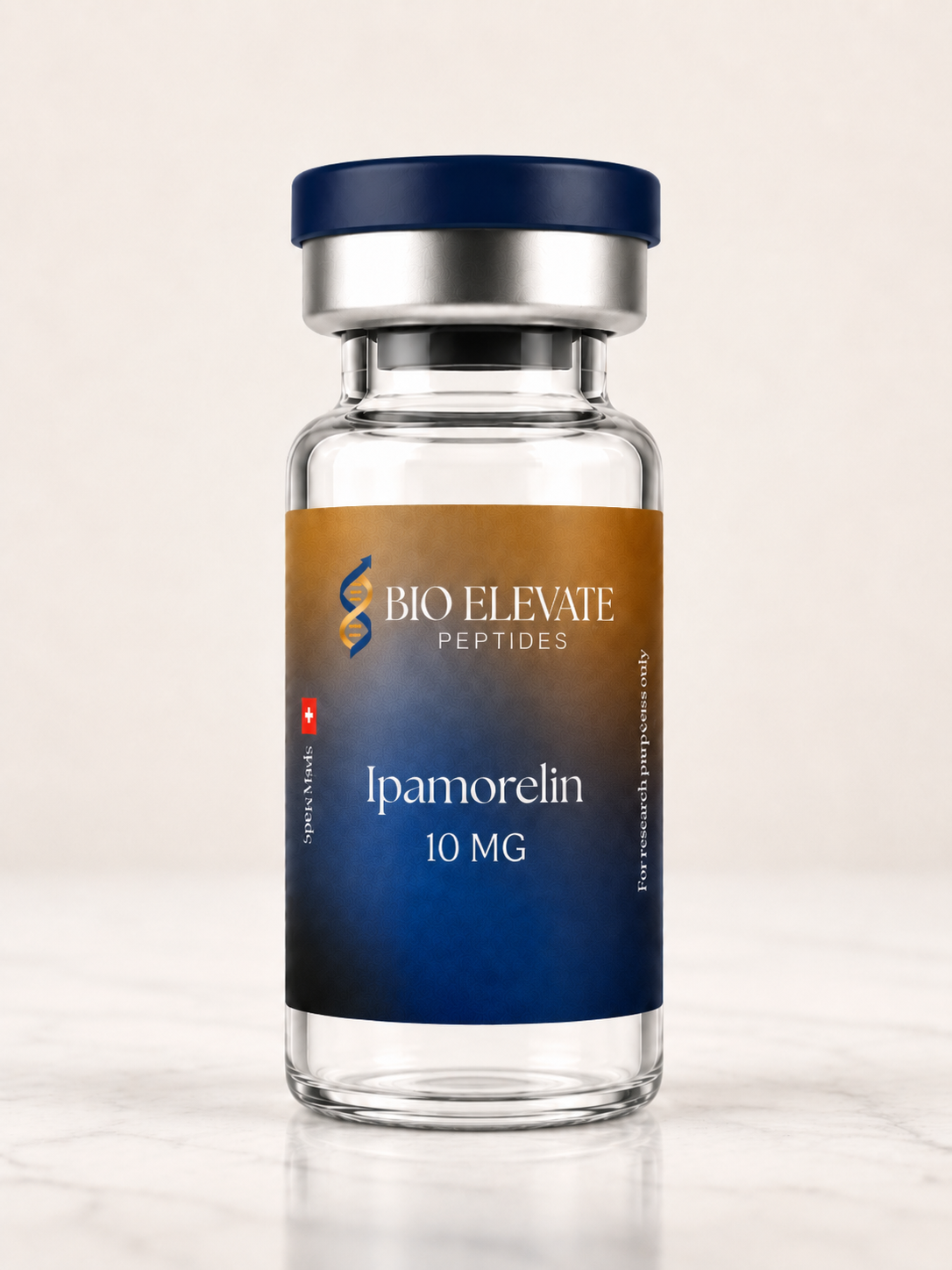
Ipamorelin | 10mg Research Grade · Swiss Manufactured · Lyophilized
Overview
Ipamorelin is a third-generation synthetic pentapeptide growth hormone secretagogue, recognized across the research community for its exceptional selectivity, clean pharmacological profile, and consistent GH release potency. As a selective agonist of the growth hormone secretagogue receptor (GHS-R1a), Ipamorelin mimics the action of ghrelin at the pituitary level, stimulating robust, dose-dependent GH pulses without the off-target hormonal activity that limits the research utility of earlier generation secretagogues such as GHRP-2 and GHRP-6. This selectivity — most notably its absence of significant cortisol, prolactin, and ACTH stimulation — has made Ipamorelin the reference standard pentapeptide secretagogue for somatotropic axis research.
Sequence
Aib-His-D-2-Nal-D-Phe-Lys-NH₂
Molecular Formula: C₃₈H₄₉N₉O₅ Molecular Weight: 711.85 g/mol CAS Number: 170851-70-4 Appearance: White lyophilized powder Purity: ≥ 99% (HPLC verified)
Mechanism of Action
Ipamorelin acts as a potent, highly selective agonist at the GHS-R1a receptor located on anterior pituitary somatotroph cells and hypothalamic neurons:
- GHS-R1a activation initiates phospholipase C-mediated intracellular signaling, elevating intracellular calcium and triggering GH granule exocytosis
- GH release occurs in a physiologically pulsatile pattern, closely mirroring endogenous secretion dynamics — a key advantage for neuroendocrine timing studies
- The Aib (α-aminoisobutyric acid) substitution at the N-terminus confers resistance to enzymatic degradation, enhancing plasma stability relative to native ghrelin fragments
- Critically, Ipamorelin demonstrates no meaningful stimulation of ACTH, cortisol, aldosterone, or prolactin at research-relevant concentrations, isolating GH axis effects with minimal neuroendocrine crosstalk
- Unlike GHRP-6, Ipamorelin does not significantly stimulate appetite pathways via hypothalamic NPY neurons, further narrowing its activity to the somatotropic axis
Selectivity Profile vs. Other GHRPs
| Property | Ipamorelin | GHRP-2 | GHRP-6 | Hexarelin |
|---|---|---|---|---|
| GH Release Potency | ✅✅✅ | ✅✅✅✅ | ✅✅✅ | ✅✅✅✅✅ |
| Cortisol Stimulation | ❌ Minimal | ⚠️ Moderate | ⚠️ Moderate | ⚠️ High |
| Prolactin Stimulation | ❌ Minimal | ⚠️ Moderate | ⚠️ Moderate | ⚠️ High |
| Appetite Stimulation | ❌ Minimal | ❌ Minimal | ⚠️ Significant | ❌ Minimal |
| Receptor Selectivity | ⭐⭐⭐⭐⭐ | ⭐⭐⭐ | ⭐⭐⭐ | ⭐⭐ |
| Research Profile Cleanliness | ⭐⭐⭐⭐⭐ | ⭐⭐⭐ | ⭐⭐⭐ | ⭐⭐ |
Research Applications
Ipamorelin’s clean selectivity and reliable GH pulse induction make it one of the most versatile peptides in the secretagogue class. Key research areas include:
- Somatotropic axis studies — isolated GH pulse modeling, GHS-R1a receptor pharmacology, and pituitary somatotroph function
- GH/IGF-1 axis research — downstream IGF-1 regulation, hepatic GH signaling, and axis feedback dynamics
- Body composition biology — lean mass accretion, lipolysis, and fat oxidation pathway studies
- Bone & connective tissue research — GH-mediated osteoblast activity, collagen synthesis, and bone mineral density models
- Age-related endocrine decline — somatopause and GH secretory capacity research in aging models
- Sleep & circadian biology — GH pulse timing relative to slow-wave sleep phases and circadian rhythm studies
- Synergy studies — combination research with GHRH analogues (e.g., CJC-1295, Sermorelin, Tesamorelin) to characterize dual-pathway GH amplification
- Metabolic research — glucose homeostasis, insulin sensitivity, and substrate utilization in GH-modulated states
Combination Research Context
Ipamorelin is frequently co-studied alongside GHRH analogues to exploit the well-documented dual-pathway synergy of the somatotropic axis:
- GHRH analogues (CJC-1295, Tesamorelin, Sermorelin) act upstream on pituitary GHRHR to drive GH synthesis and release
- Ipamorelin acts simultaneously via GHS-R1a through a distinct intracellular mechanism, amplifying GH pulse magnitude
- The combined effect produces supraadditive GH secretion that neither compound generates independently, while maintaining physiological pulsatility
BioElevate offers the Ipamorelin/CJC-1295 blend for researchers preferring a pre-combined formulation.
Quality & Manufacturing
BioElevate Ipamorelin is synthesized in our Swiss GMP-compliant facility using solid-phase peptide synthesis (SPPS) with Fmoc chemistry, incorporating the structurally critical D-amino acid substitutions and Aib N-terminal modification under strict stereochemical control. Each batch undergoes full independent quality verification:
- Reverse-phase HPLC — purity ≥ 99% confirmed
- High-resolution mass spectrometry (HRMS) — molecular weight and sequence confirmation
- Chiral purity testing — D-amino acid integrity verification
- Endotoxin testing — LAL method, endotoxin-free certification
- Sterility testing — USP <71> compliant
- Certificate of Analysis (CoA) — issued per batch, available upon request
Supplied As
- 10mg lyophilized powder per vial
- Sealed under inert nitrogen atmosphere to prevent oxidation
- Recommended storage: −20°C, protected from light and moisture
- Shelf life: 24 months (lyophilized); 30 days (reconstituted at 4°C)
Reconstitution
Reconstitute with sterile bacteriostatic water. Introduce solvent slowly along the inner vial wall. Gently swirl until the lyophilized cake is fully dissolved. Do not vortex or shake vigorously. Allow vial to equilibrate to room temperature prior to use. Once reconstituted, store at 4°C and use within 30 days.
⚠️ For Research Use Only. This product is intended solely for in vitro and laboratory research purposes. Not for human or veterinary use. Not for consumption. BioElevate products are sold exclusively to licensed research institutions and qualified professionals.
Reviews
There are no reviews yet.