
Description
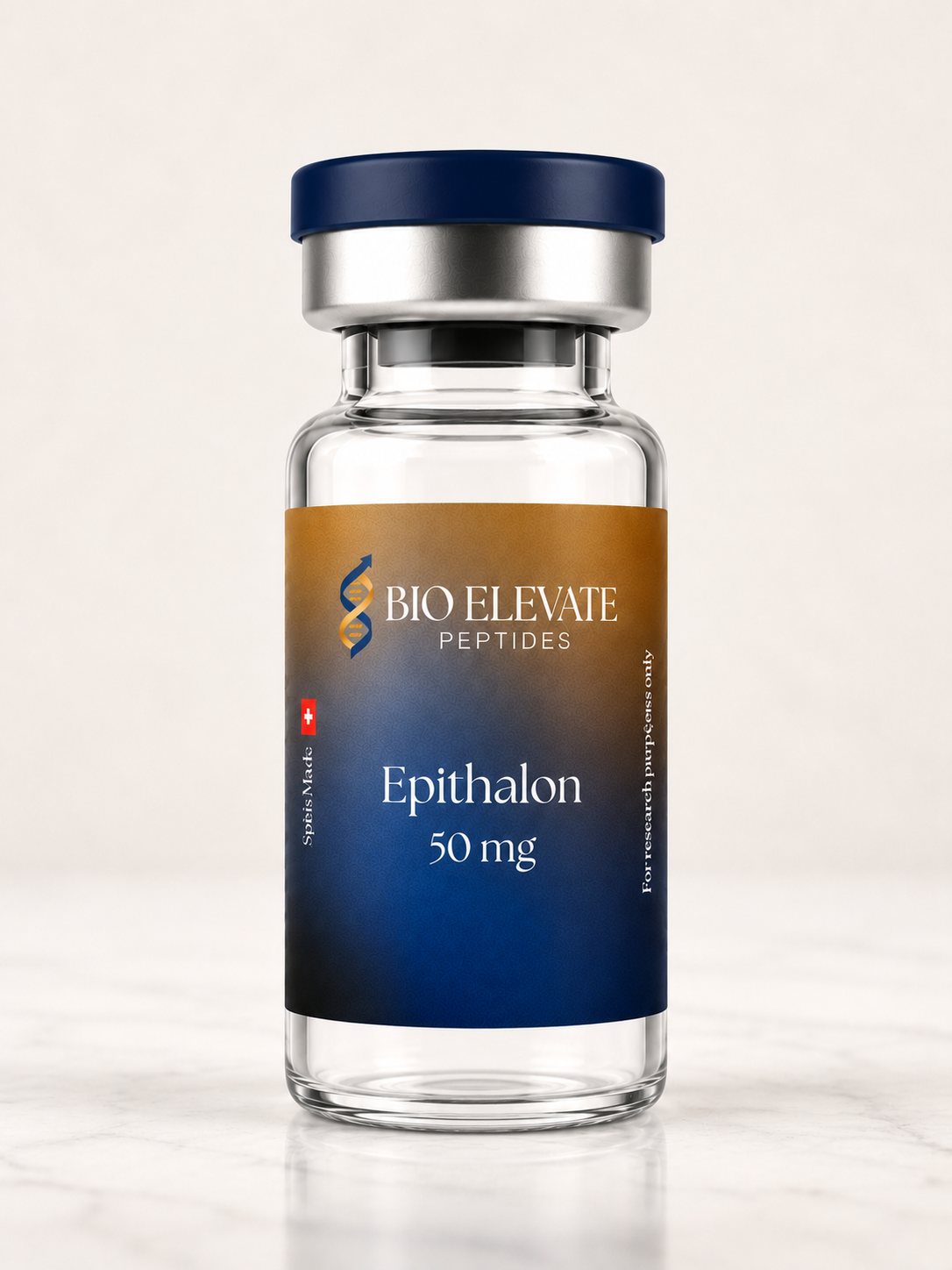
Epithalon | 50mg Research Grade · Swiss Manufactured · Lyophilized
Overview
Epithalon (also referred to as Epitalon or Epithalone) is a synthetic tetrapeptide analogue of Epithalamin — a naturally occurring polypeptide extract of the pineal gland — consisting of four amino acids in the sequence Ala-Glu-Asp-Gly. First identified and developed by Professor Vladimir Khavinson at the St. Petersburg Institute of Bioregulation and Gerontology, Epithalon has accumulated over four decades of research across Soviet, Russian, and international scientific institutions, establishing one of the most extensive longitudinal research foundations of any peptide in the biogerontology field. Its primary area of scientific interest lies in the regulation of telomerase activity, telomere biology, and the broader mechanisms of cellular senescence — positioning it as arguably the most studied peptide in longevity and anti-aging research. Beyond its telomeric activity, Epithalon has demonstrated a remarkably wide range of biological effects spanning neuroendocrine regulation, circadian rhythm modulation, antioxidant defense, and oncostatic activity, making it a uniquely multi-dimensional research tool in the peptide science landscape.
Sequence
Ala-Glu-Asp-Gly
Molecular Formula: C₁₄H₂₂N₄O₉ Molecular Weight: 390.35 g/mol CAS Number: 307297-39-8 Appearance: White lyophilized powder Purity: ≥ 99% (HPLC verified)
Mechanism of Action
Epithalon operates through several distinct but interrelated molecular mechanisms that collectively position it as a uniquely broad-spectrum research compound in cellular and systems biology:
Telomerase Activation & Telomere Elongation
- Epithalon is the only peptide demonstrated in peer-reviewed research to activate telomerase (hTERT) in somatic cells — the enzyme responsible for maintaining and restoring telomere length
- By upregulating telomerase expression, Epithalon has been shown in multiple cell culture studies to elongate telomeres in aging human cells, reversing a key molecular hallmark of cellular senescence
- This activity has profound implications for replicative lifespan extension, DNA integrity maintenance, and senescent cell biology research
Pineal Gland & Neuroendocrine Regulation
- As a structural analogue of Epithalamin, Epithalon directly influences pineal gland function, regulating the synthesis and secretion of melatonin via modulation of pinealocyte activity
- This interaction supports research into circadian rhythm normalization, age-related melatonin decline, and the pineal-hypothalamic-pituitary axis
- Downstream effects on cortisol regulation, gonadotropin secretion, and hypothalamic sensitivity have been characterized across multiple animal model studies
Antioxidant & Oxidative Stress Defense
- Epithalon upregulates endogenous antioxidant enzyme activity — including superoxide dismutase (SOD) and glutathione peroxidase — reducing oxidative damage to lipids, proteins, and DNA
- Reduction of lipid peroxidation markers and reactive oxygen species (ROS) accumulation has been consistently reported in aged tissue models, directly relevant to oxidative stress biology and longevity research
Chromatin & Gene Expression Regulation
- Research suggests Epithalon modulates chromatin remodeling and heterochromatin structure, influencing the transcriptional accessibility of longevity-associated genes
- This epigenetic dimension of its activity positions it at the intersection of geroscience and epigenomics, two of the most rapidly expanding fields in contemporary biological research
Oncostatic Activity
- Multiple studies have investigated Epithalon’s capacity to inhibit aberrant cell proliferation and tumor development in carcinogen-exposed models, potentially via cell cycle checkpoint modulation and normalization of growth factor receptor expression
Research Applications
Epithalon’s unique combination of telomeric, neuroendocrine, and cytoprotective activity generates a research profile that spans several of the most active frontiers in modern biology:
Telomere Biology & Cellular Senescence
- Telomerase activation mechanisms and hTERT expression regulation
- Replicative senescence modeling and cellular lifespan extension studies
- DNA damage response and genomic stability research
- Senolytic and senomorphic pathway investigations
Longevity & Biogerontology Research
- One of the most extensively studied peptides in lifespan extension models — preclinical studies have reported up to 33% mean lifespan extension in animal models
- Hallmarks of aging research — telomere attrition, mitochondrial dysfunction, epigenetic alterations, and loss of proteostasis
- Age-related functional decline modeling across multiple organ systems
Neuroendocrine & Pineal Biology
- Pineal gland function, melatonin biosynthesis regulation, and photoperiodic signaling
- Circadian rhythm disruption models and age-related chronobiological decline
- HPA axis regulation and age-related neuroendocrine desynchronization
Oncology Research
- Carcinogenesis prevention models, tumor suppression pathway studies
- Aberrant cell proliferation and cell cycle dysregulation research
- Interaction between telomere dynamics and oncogenic transformation
Retinal & Visual System Research
- Studies have investigated its role in retinal pigment epithelium (RPE) cell preservation and photoreceptor function in aging retinal models
- Relevant to age-related macular degeneration (AMD) and retinal senescence research
Immune System & Inflammation Research
- Age-related immune decline (immunosenescence) and thymic function studies
- Regulatory T-cell activity and cytokine balance in aging models
- Chronic low-grade inflammation (inflammaging) pathway research
Oxidative Stress Biology
- ROS accumulation, lipid peroxidation, and mitochondrial oxidative damage studies
- Endogenous antioxidant enzyme regulation and redox homeostasis research
Research Heritage & Scientific Pedigree
Epithalon carries a scientific history that is unmatched among synthetic peptides in the longevity research space:
- Developed from over 40 years of continuous research originating at the St. Petersburg Institute of Bioregulation and Gerontology under Professor V.Kh. Khavinson
- Featured in peer-reviewed publications across journals including the Bulletin of Experimental Biology and Medicine, Neuro Endocrinology Letters, and Biogerontology
- Preclinical studies have demonstrated lifespan extension, tumor incidence reduction, and functional preservation across multiple mammalian species
- One of the few peptides with both in vitro telomerase activation data and longitudinal in vivo lifespan data, a combination that remains exceptionally rare in the peptide research literature
Comparative Profile — Longevity & Anti-Aging Peptide Class
| Property | Epithalon | Thymalin | Selank | BPC-157 |
|---|---|---|---|---|
| Telomerase Activation | ⭐⭐⭐⭐⭐ | ❌ | ❌ | ❌ |
| Pineal / Melatonin Regulation | ⭐⭐⭐⭐⭐ | ⭐⭐ | ❌ | ❌ |
| Antioxidant Activity | ⭐⭐⭐⭐ | ⭐⭐⭐ | ⭐⭐⭐ | ⭐⭐⭐ |
| Longevity Research Data | ⭐⭐⭐⭐⭐ | ⭐⭐⭐⭐ | ⭐⭐ | ⭐⭐⭐ |
| Neuroendocrine Modulation | ⭐⭐⭐⭐ | ⭐⭐⭐ | ⭐⭐⭐⭐ | ⭐⭐ |
| Immune System Research | ⭐⭐⭐ | ⭐⭐⭐⭐⭐ | ⭐⭐⭐ | ⭐⭐⭐ |
| Tissue Repair Activity | ⭐⭐ | ⭐⭐ | ❌ | ⭐⭐⭐⭐⭐ |
| Research Publication Volume | ⭐⭐⭐⭐⭐ | ⭐⭐⭐⭐ | ⭐⭐⭐ | ⭐⭐⭐⭐⭐ |
Quality & Manufacturing
BioElevate Epithalon is synthesized in our Swiss GMP-compliant facility using solid-phase peptide synthesis (SPPS) with Fmoc chemistry. Despite its short tetrapeptide sequence, precise stereochemical fidelity and coupling efficiency at each step are rigorously controlled to ensure the biologically active L-amino acid configuration is maintained throughout. Every batch undergoes comprehensive independent quality verification:
- Reverse-phase HPLC — purity ≥ 99% confirmed
- High-resolution mass spectrometry (HRMS) — full molecular weight and sequence integrity confirmation
- Chiral purity analysis — L-amino acid configuration verification
- Endotoxin testing — LAL method, endotoxin-free certification
- Sterility testing — USP <71> compliant
- Amino acid analysis (AAA) — compositional verification
- Certificate of Analysis (CoA) — issued per batch, available upon request
Supplied As
- 50mg lyophilized powder per vial
- Sealed under inert nitrogen atmosphere to prevent oxidation
- Recommended storage: −20°C, protected from light and moisture
- Shelf life: 24 months (lyophilized); 30 days (reconstituted at 4°C)
- Larger format vial ideal for extended research protocols and multi-experiment studies
Reconstitution
Reconstitute with sterile bacteriostatic water. For a 50mg vial, introduce solvent slowly along the inner vial wall in incremental additions, gently swirling between each addition until the lyophilized cake is fully dissolved. Do not vortex or shake vigorously. Allow the vial to equilibrate to room temperature prior to use. Once reconstituted, store at 4°C and use within 30 days. Aliquoting into smaller working volumes prior to storage is recommended to avoid repeated freeze-thaw cycles and preserve peptide integrity across extended research timelines.
⚠️ For Research Use Only. This product is intended solely for in vitro and laboratory research purposes. Not for human or veterinary use. Not for consumption. BioElevate products are sold exclusively to licensed research institutions and qualified professionals.
Reviews
There are no reviews yet.