
Description
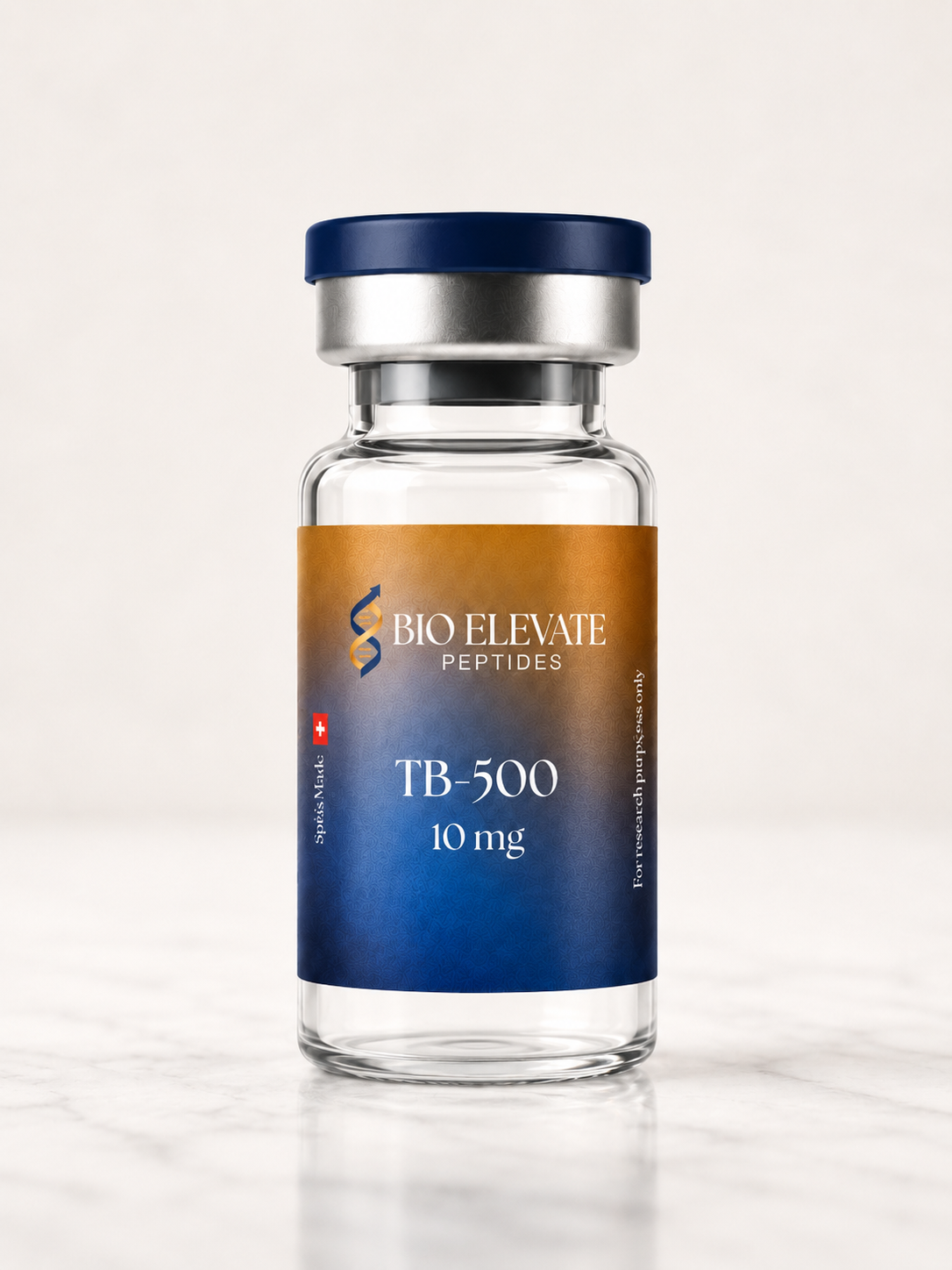
TB-500 | 10mg Research Grade · Swiss Manufactured · Lyophilized
Overview
TB-500 is a synthetic analogue of the 17-23 amino acid active domain of Thymosin Beta-4 (Tβ4) — a ubiquitous, highly conserved 43-amino acid peptide originally isolated from bovine thymus tissue and subsequently identified as one of the most abundantly expressed intracellular peptides in virtually every mammalian cell type. Tβ4 itself is encoded by the TMSB4X gene and plays a foundational role in actin dynamics, cell migration, differentiation, and tissue homeostasis across a remarkable breadth of biological contexts. TB-500 isolates the actin-binding heptapeptide sequence Ac-LKKTETQ — the minimal bioactive domain responsible for the majority of Tβ4’s biological activity — delivering the core regenerative, angiogenic, and anti-inflammatory effects of the full-length peptide in a structurally simplified, highly soluble, and exceptionally stable synthetic fragment. First brought into focused research attention through the work of Dr. Allan Goldstein and colleagues at George Washington University, TB-500 has since accumulated one of the most compelling and multi-system research profiles in the regenerative peptide landscape. Its defining biological characteristic — the promotion of actin polymerization, cell migration, and neovascularization across virtually every tissue type in which it has been studied — has made it an indispensable research tool in wound healing, cardiovascular biology, musculoskeletal repair, neurological regeneration, and inflammatory disease research. When studied alongside BPC-157, TB-500 represents the complementary systemic counterpart to BPC-157’s more localized repair activity, and the two peptides together constitute arguably the most comprehensively studied regenerative research pairing in modern peptide science.
Sequence
Ac-Leu-Lys-Lys-Thr-Glu-Thr-Gln-OH (Ac-LKKTETQ — active fragment of Thymosin Beta-4 residues 17-23)
Molecular Formula: C₃₄H₆₀N₁₀O₁₄ Molecular Weight: 836.90 g/mol CAS Number: 77591-33-4 Appearance: White lyophilized powder Purity: ≥ 99% (HPLC verified)
Structural Context — TB-500 Within the Thymosin Beta-4 Framework
| Peptide | Length | Key Feature |
|---|---|---|
| Thymosin Beta-4 (full) | 43 AA | Complete intracellular actin sequestering protein |
| TB-500 (Ac-LKKTETQ) | 7 AA | Isolated actin-binding bioactive domain (residues 17-23) |
- The N-terminal acetylation (Ac-) is structurally preserved from the native Tβ4 sequence and is functionally critical — it contributes to actin monomer binding affinity and membrane interaction geometry
- The heptapeptide fragment retains the G-actin sequestering activity of full-length Tβ4 while demonstrating superior aqueous solubility, enhanced tissue penetration, and greater metabolic stability
- TB-500’s small molecular weight relative to full-length Tβ4 enables systemic distribution following administration in research models, with demonstrated activity across anatomically distant tissue compartments — a key pharmacokinetic advantage in multi-tissue repair research
- The lysine residues at positions 2 and 3 (Lys-Lys) contribute to the peptide’s cationic character, facilitating cell membrane interaction and intracellular uptake across diverse cell types
Mechanism of Action
TB-500 operates through a set of interconnected molecular mechanisms centered on actin cytoskeletal dynamics and their downstream consequences for cell motility, tissue repair, angiogenesis, and inflammation:
G-Actin Sequestration & Cytoskeletal Regulation
- TB-500’s primary molecular mechanism is sequestration of G-actin monomers — binding free globular actin with high affinity to regulate the pool available for filamentous F-actin polymerization
- This cytoskeletal regulatory activity directly controls cell shape, motility, and division — fundamental processes in wound healing, tissue remodeling, and regeneration
- By modulating the G-actin/F-actin equilibrium, TB-500 promotes the lamellipodia and filopodia formation necessary for directed cell migration toward wound sites and areas of tissue damage
- Regulation of actin dynamics is relevant across virtually every proliferating and migrating cell type — fibroblasts, endothelial cells, keratinocytes, cardiomyocytes, satellite cells, and neurons — explaining TB-500’s broad multi-tissue activity profile
Angiogenesis & Vascular Remodeling
- TB-500 is a potent stimulator of endothelial cell migration and tube formation — the cellular processes underlying new blood vessel sprouting and capillary network assembly
- Upregulates VEGF receptor expression and sensitizes endothelial cells to angiogenic growth factor signaling
- Promotes arteriogenesis — the remodeling and enlargement of existing collateral vessels — in addition to de novo capillary sprouting, making it particularly relevant to ischemic tissue research
- Neovascularization driven by TB-500 restores blood supply and oxygen delivery to hypoxic or ischemic tissue, accelerating the metabolic prerequisites for repair and regeneration
Anti-Inflammatory Signaling
- TB-500 downregulates NF-κB pathway activation and attenuates production of pro-inflammatory cytokines including TNF-α, IL-1β, IL-6, and IFN-γ across multiple cell types
- Promotes macrophage polarization from the M1 pro-inflammatory phenotype toward the M2 pro-resolving, pro-repair phenotype — a critical transition in the transition from acute inflammation to tissue repair
- Reduces neutrophil and macrophage infiltration into injured tissue in multiple preclinical models, dampening destructive inflammatory tissue remodeling while preserving necessary immune surveillance
- Modulates the sphingosine-1-phosphate (S1P) signaling pathway, a key mediator of inflammatory cell trafficking and vascular permeability
Cell Survival & Anti-Apoptotic Signaling
- TB-500 activates the PI3K/Akt survival pathway, promoting cell survival under conditions of oxidative stress, ischemia, and cytotoxic challenge
- Upregulates expression of anti-apoptotic Bcl-2 family proteins while suppressing pro-apoptotic Bax expression in ischemic tissue models
- This cytoprotective activity is particularly well-documented in cardiomyocyte and neuronal contexts, where post-injury cell survival is a primary determinant of functional recovery
Stem Cell Recruitment & Progenitor Cell Activation
- TB-500 promotes mobilization of cardiac progenitor cells, satellite cells, and endothelial progenitor cells from their tissue niches to sites of injury
- Upregulates expression of CXCR4 and SDF-1 — the chemokine receptor-ligand pair governing stem cell homing to injured tissue
- Facilitates cardiomyocyte proliferation from pre-existing cardiomyocytes and resident cardiac stem cells — a finding of considerable significance in cardiac regeneration research
Extracellular Matrix Interaction & Tissue Remodeling
- TB-500 modulates MMP and TIMP expression, regulating ECM degradation and remodeling to support cell migration through damaged matrix and progressive tissue reconstruction
- Interacts with the integrin signaling network via its effects on actin cytoskeletal organization, influencing focal adhesion dynamics and cell-matrix communication critical to directed migration
- Promotes fibroblast activation and collagen deposition in a contextually appropriate, remodeling-oriented rather than fibrosis-promoting manner
Research Applications
TB-500’s actin-centric mechanism of action and systemic distribution profile generate a remarkably broad research footprint spanning multiple organ systems:
Cardiovascular Research
- The most extensively investigated application — cardiac ischemia-reperfusion injury models and myocardial infarction repair
- Cardiomyocyte survival, proliferation, and cardiac progenitor cell mobilization studies
- Heart failure models — myocardial remodeling, fibrosis prevention, and functional recovery research
- Cardiac angiogenesis and collateral vessel development in ischemic myocardium
- Vascular endothelial repair and atherosclerosis plaque biology
- Stroke models — cerebrovascular ischemia and neurovascular unit repair research
Musculoskeletal & Connective Tissue Research
- Skeletal muscle injury repair — crush injury, laceration, and contusion models
- Tendon and ligament repair — fibroblast activation, collagen remodeling, and mechanical property restoration studies
- Bone healing and fracture repair — osteoblast activity and periosteal regeneration models
- Rotator cuff, Achilles tendon, and anterior cruciate ligament injury models
- Muscle satellite cell activation and myofiber regeneration research
- Joint cartilage repair — chondrocyte biology and articular cartilage remodeling studies
Neurological Research
- Spinal cord injury models — axonal regeneration, remyelination, and functional recovery studies
- Traumatic brain injury (TBI) — secondary injury cascade attenuation and neural repair research
- Peripheral nerve regeneration — Schwann cell migration, axonal sprouting, and nerve conduit research
- Stroke recovery — neuroplasticity, cortical remapping, and perilesional tissue preservation
- Neuroinflammation models — microglial activation and blood-brain barrier integrity studies
- Multiple sclerosis models — myelin repair and oligodendrocyte precursor cell activation research
Wound Healing & Dermatology Research
- Acute wound healing — inflammatory phase modulation, granulation tissue formation, and re-epithelialization
- Chronic wound models — diabetic ulcers, venous ulcers, and pressure wound healing research
- Burn injury models — dermal regeneration and scar remodeling studies
- Keratinocyte migration and epidermal sheet advancement research
- Corneal wound healing — a particularly well-studied TB-500 application given the transparent, easily imaged corneal tissue model
- Dry eye and ocular surface disease models
Pulmonary Research
- Lung injury models — bleomycin-induced fibrosis, LPS-induced acute lung injury
- Alveolar epithelial repair and surfactant system restoration studies
- Pulmonary vascular remodeling and hypoxia-induced angiogenesis research
- COPD-associated tissue destruction and repair pathway studies
Renal Research
- Acute kidney injury models — ischemia-reperfusion and nephrotoxic injury
- Tubular epithelial cell migration and repair studies
- Renal fibrosis attenuation and TGF-β pathway modulation research
Gastrointestinal Research
- Intestinal mucosal repair and barrier integrity studies
- Hepatic injury models — liver fibrosis, ischemic hepatitis, and regeneration after partial hepatectomy
- Pancreatic tissue repair and islet cell biology
Comparative Profile — Regenerative Peptide Class
| Property | TB-500 | BPC-157 | GHK-Cu | KPV |
|---|---|---|---|---|
| Primary Mechanism | Actin dynamics / Cell migration | Multi-pathway cytoprotection | Gene reprogramming / ECM | NF-κB / MC receptor |
| Systemic Distribution | ⭐⭐⭐⭐⭐ | ⭐⭐⭐ | ⭐⭐⭐⭐ | ⭐⭐⭐ |
| Cardiac Repair Research | ⭐⭐⭐⭐⭐ | ⭐⭐⭐ | ⭐⭐⭐ | ⭐⭐ |
| Musculoskeletal Repair | ⭐⭐⭐⭐⭐ | ⭐⭐⭐⭐⭐ | ⭐⭐⭐ | ⭐⭐ |
| Neurological Repair | ⭐⭐⭐⭐⭐ | ⭐⭐⭐⭐ | ⭐⭐⭐⭐ | ⭐⭐⭐ |
| Angiogenesis | ⭐⭐⭐⭐⭐ | ⭐⭐⭐⭐ | ⭐⭐⭐⭐ | ⭐⭐ |
| GI Mucosal Repair | ⭐⭐⭐ | ⭐⭐⭐⭐⭐ | ⭐⭐⭐ | ⭐⭐⭐⭐⭐ |
| Anti-inflammatory Activity | ⭐⭐⭐⭐ | ⭐⭐⭐⭐⭐ | ⭐⭐⭐⭐⭐ | ⭐⭐⭐⭐⭐ |
| Wound Healing | ⭐⭐⭐⭐⭐ | ⭐⭐⭐⭐⭐ | ⭐⭐⭐⭐⭐ | ⭐⭐⭐⭐ |
| Research Publication Volume | ⭐⭐⭐⭐⭐ | ⭐⭐⭐⭐⭐ | ⭐⭐⭐⭐⭐ | ⭐⭐⭐ |
Combination Research Context
TB-500 is most frequently co-investigated with BPC-157, forming the most widely studied regenerative peptide combination in the research literature. Their mechanistic complementarity is architecturally elegant:
- TB-500 drives systemic, actin-mediated cell migration, endothelial progenitor mobilization, and broad neovascularization — operating across anatomically distributed tissue compartments
- BPC-157 delivers localized, multi-pathway cytoprotection — angiogenesis via VEGF upregulation, fibroblast activation via FAK-paxillin signaling, and growth factor receptor sensitization at specific injury sites
- Together they provide complementary spatial coverage — TB-500’s systemic reach combined with BPC-157’s localized depth — and mechanistic redundancy across key repair pathways including angiogenesis and anti-inflammatory signaling
- The combination has been studied across musculoskeletal, gastrointestinal, neurological, and cardiovascular injury models with consistently synergistic outcomes
BioElevate offers the BPC-157/TB-500 blend for researchers requiring a pre-combined formulation with precisely controlled stoichiometry.
Additional research pairings of interest:
- TB-500 + SS-31 — cardiovascular ischemia-reperfusion research combining TB-500’s cell migration and angiogenic activity with SS-31’s mitochondrial cytoprotection and ETC optimization
- TB-500 + GHK-Cu — comprehensive wound healing and tissue remodeling research covering cell migration, angiogenesis, ECM synthesis, and transcriptional reprogramming across all phases of the repair response
- TB-500 + MOTS-c — metabolic and skeletal muscle repair research combining TB-500’s satellite cell activation and myofiber regeneration activity with MOTS-c’s mitochondrial biogenesis and AMPK-mediated metabolic reprogramming
Quality & Manufacturing
BioElevate TB-500 is synthesized in our Swiss GMP-compliant facility using solid-phase peptide synthesis (SPPS) with Fmoc chemistry, incorporating the structurally essential N-terminal acetylation via acetic anhydride capping during synthesis — a modification verified at the mass spectrometric level for every production batch. The heptapeptide sequence is assembled with full coupling efficiency verification at each residue position. Every batch undergoes comprehensive independent quality verification:
- Reverse-phase HPLC — purity ≥ 99% confirmed
- High-resolution mass spectrometry (HRMS) — full molecular weight and N-terminal acetylation confirmation
- N-terminal acetylation integrity verification — structurally critical modification confirmed per batch
- Endotoxin testing — LAL method, endotoxin-free certification
- Sterility testing — USP <71> compliant
- Amino acid analysis (AAA) — compositional sequence verification
- Certificate of Analysis (CoA) — issued per batch, available upon request
Supplied As
- 10mg lyophilized powder per vial
- Sealed under inert nitrogen atmosphere to prevent oxidation
- Recommended storage: −20°C, protected from light and moisture
- Shelf life: 24 months (lyophilized); 30 days (reconstituted at 4°C)
Reconstitution
Reconstitute with sterile bacteriostatic water or sterile saline. TB-500 demonstrates excellent aqueous solubility consistent with its hydrophilic heptapeptide structure and cationic character. Introduce solvent slowly along the inner vial wall and gently swirl until the lyophilized cake is fully dissolved. Do not vortex or shake vigorously. Allow the vial to equilibrate to room temperature prior to use. Once reconstituted, store at 4°C and use within 30 days. Aliquoting into smaller working volumes prior to storage is recommended to eliminate repeated freeze-thaw exposure and preserve peptide integrity across extended research timelines.
⚠️ For Research Use Only. This product is intended solely for in vitro and laboratory research purposes. Not for human or veterinary use. Not for consumption. BioElevate products are sold exclusively to licensed research institutions and qualified professionals.
Reviews
There are no reviews yet.