
Description
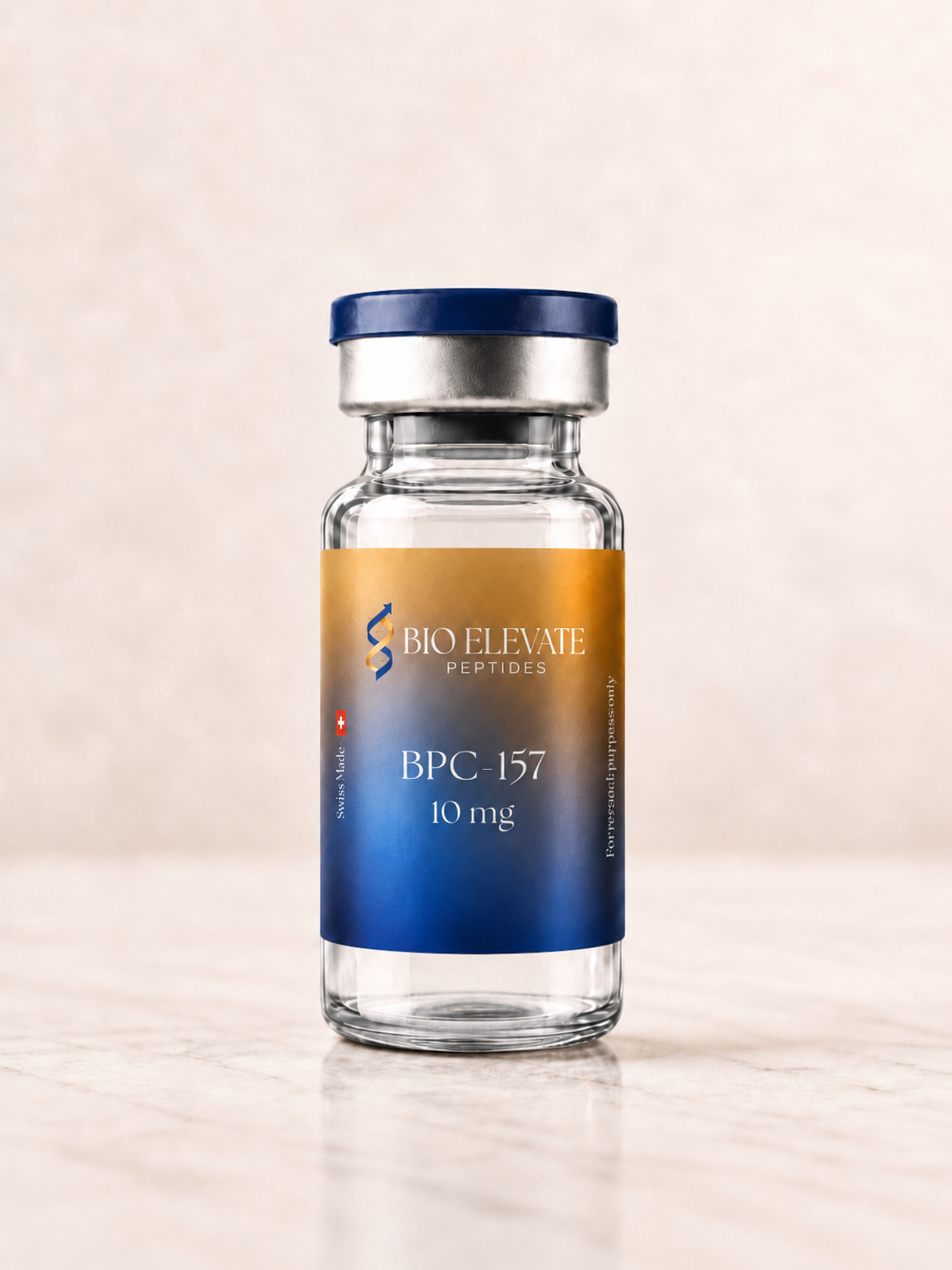
BPC-157 | 10mg Research Grade · Swiss Manufactured · Lyophilized
Overview
BPC-157 (Body Protection Compound-157) is a synthetic pentadecapeptide consisting of 15 amino acids, derived from a partial sequence of the human gastric juice protein BPC. First isolated and characterized in the 1990s, BPC-157 has since emerged as one of the most extensively researched cytoprotective and regenerative peptides in modern preclinical biology. What distinguishes BPC-157 from the broader peptide research landscape is the remarkable breadth of its biological activity — demonstrating consistent effects across gastrointestinal, musculoskeletal, neurological, and vascular systems through multiple converging molecular pathways. Its exceptional stability in biological fluids and absence of significant toxicity signals across a wide range of studied concentrations have made it a foundational tool in regenerative biology and tissue repair research.
Sequence
Gly-Glu-Pro-Pro-Pro-Gly-Lys-Pro-Ala-Asp-Asp-Ala-Gly-Leu-Val
Molecular Formula: C₆₂H₉₈N₁₆O₂₂ Molecular Weight: 1419.53 g/mol CAS Number: 137525-51-0 Appearance: White lyophilized powder Purity: ≥ 99% (HPLC verified)
Mechanism of Action
BPC-157 exerts its cytoprotective and regenerative effects through a multifactorial mechanism involving several distinct but interconnected signaling pathways:
- Nitric oxide (NO) system modulation — upregulates eNOS expression and NO production, driving vasodilation, angiogenesis, and endothelial repair in injured tissue
- VEGF pathway activation — stimulates vascular endothelial growth factor expression, accelerating neovascularization and blood supply restoration to ischemic or damaged tissue
- FAK-paxillin pathway engagement — promotes fibroblast migration and cytoskeletal reorganization critical to wound closure and extracellular matrix remodeling
- Growth factor receptor upregulation — enhances expression of EGF, FGF, and PDGF receptors at injury sites, amplifying endogenous repair signal sensitivity
- Tendon-to-bone junction signaling — activates the FAK and paxillin outgrowth tendon fibroblast pathway, a key mechanism underlying its well-documented musculotendinous repair activity
- GABAergic & dopaminergic modulation — interacts with central neurotransmitter systems, contributing to its neuroprotective and CNS-relevant research applications
- NF-κB pathway inhibition — attenuates pro-inflammatory cytokine cascades, contributing to its consistent anti-inflammatory profile across tissue types
Research Applications
BPC-157 commands one of the broadest research profiles of any peptide in its class, spanning multiple organ systems and biological processes:
Gastrointestinal Research
- Gastric ulcer healing, intestinal anastomosis repair, and mucosal integrity studies
- Inflammatory bowel disease models — colitis, Crohn’s-like lesion resolution
- Gut-brain axis research and enteric nervous system modulation
- Esophageal and fistula healing models
Musculoskeletal & Connective Tissue Research
- Tendon, ligament, and muscle tear repair models
- Bone healing and fracture repair studies
- Rotator cuff, Achilles tendon, and anterior cruciate ligament (ACL) injury models
- Cartilage and joint tissue repair research
Neurological Research
- Traumatic brain injury (TBI) and spinal cord injury models
- Peripheral nerve regeneration studies
- Neuroprotection against excitotoxic and ischemic insult
- Dopaminergic system research — Parkinson’s-adjacent pathway studies
- Depression and anxiety models via GABAergic modulation
Vascular & Cardiovascular Research
- Angiogenesis and endothelial repair studies
- Thrombosis and ischemia-reperfusion injury models
- Superior mesenteric artery occlusion research
Systemic Cytoprotection
- Organ protection models — liver, kidney, heart, and lung cytoprotection
- NSAID and corticosteroid-induced tissue damage counteraction studies
- Systemic inflammatory response and sepsis models
Stability Profile
A defining characteristic of BPC-157 that distinguishes it from many research peptides is its remarkable stability:
- Gastric acid stability — retains biological activity in highly acidic environments, unlike most peptides which are rapidly degraded
- Plasma stability — demonstrates resistance to proteolytic degradation in biological fluids
- No carrier protein required — active as a free peptide without albumin binding or complexation
- Aqueous solubility — highly soluble in aqueous solutions, simplifying reconstitution and administration across research models
Comparative Research Breadth
| Research Domain | BPC-157 | TB-500 | Sermorelin | Ipamorelin |
|---|---|---|---|---|
| GI Tract Repair | ⭐⭐⭐⭐⭐ | ⭐⭐ | ❌ | ❌ |
| Tendon / Ligament Repair | ⭐⭐⭐⭐⭐ | ⭐⭐⭐⭐ | ❌ | ❌ |
| Neurological Protection | ⭐⭐⭐⭐ | ⭐⭐ | ⭐ | ⭐ |
| Angiogenesis / Vascular | ⭐⭐⭐⭐ | ⭐⭐⭐⭐⭐ | ⭐⭐ | ⭐⭐ |
| GH / Somatotropic Axis | ❌ | ❌ | ⭐⭐⭐⭐⭐ | ⭐⭐⭐⭐⭐ |
| Anti-inflammatory Activity | ⭐⭐⭐⭐⭐ | ⭐⭐⭐ | ⭐⭐ | ⭐⭐ |
| Research Data Volume | ⭐⭐⭐⭐⭐ | ⭐⭐⭐⭐ | ⭐⭐⭐⭐ | ⭐⭐⭐⭐ |
Combination Research Context
BPC-157 is frequently co-studied with TB-500 (Thymosin Beta-4) to investigate complementary tissue repair mechanisms:
- BPC-157 drives localized repair via angiogenesis, fibroblast activation, and growth factor receptor upregulation
- TB-500 promotes systemic actin regulation, cell migration, and anti-inflammatory signaling across a broader tissue distribution
- Together, they represent a mechanistically complementary pairing for comprehensive regenerative biology research
BioElevate offers the BPC-157/TB-500 blend for researchers requiring a pre-combined formulation.
Quality & Manufacturing
BioElevate BPC-157 is synthesized in our Swiss GMP-compliant facility using solid-phase peptide synthesis (SPPS) with Fmoc chemistry, with particular attention to the proline-rich central sequence that demands precise coupling efficiency at each synthetic step. Every batch undergoes rigorous independent quality verification:
- Reverse-phase HPLC — purity ≥ 99% confirmed
- High-resolution mass spectrometry (HRMS) — full molecular weight and sequence integrity confirmation
- Endotoxin testing — LAL method, endotoxin-free certification
- Sterility testing — USP <71> compliant
- Amino acid analysis (AAA) — compositional sequence verification
- Certificate of Analysis (CoA) — issued per batch, available upon request
Supplied As
- 10mg lyophilized powder per vial
- Sealed under inert nitrogen atmosphere to prevent oxidation
- Recommended storage: −20°C, protected from light and moisture
- Shelf life: 24 months (lyophilized); 30 days (reconstituted at 4°C)
Reconstitution
Reconstitute with sterile bacteriostatic water or sterile saline. Introduce solvent slowly along the inner vial wall to minimize foaming. Gently swirl until the lyophilized cake is fully dissolved. Do not vortex or shake vigorously. Allow the vial to equilibrate to room temperature prior to use. Once reconstituted, store at 4°C and use within 30 days. Avoid repeated freeze-thaw cycles.
⚠️ For Research Use Only. This product is intended solely for in vitro and laboratory research purposes. Not for human or veterinary use. Not for consumption. BioElevate products are sold exclusively to licensed research institutions and qualified professionals.
Reviews
There are no reviews yet.