
Description
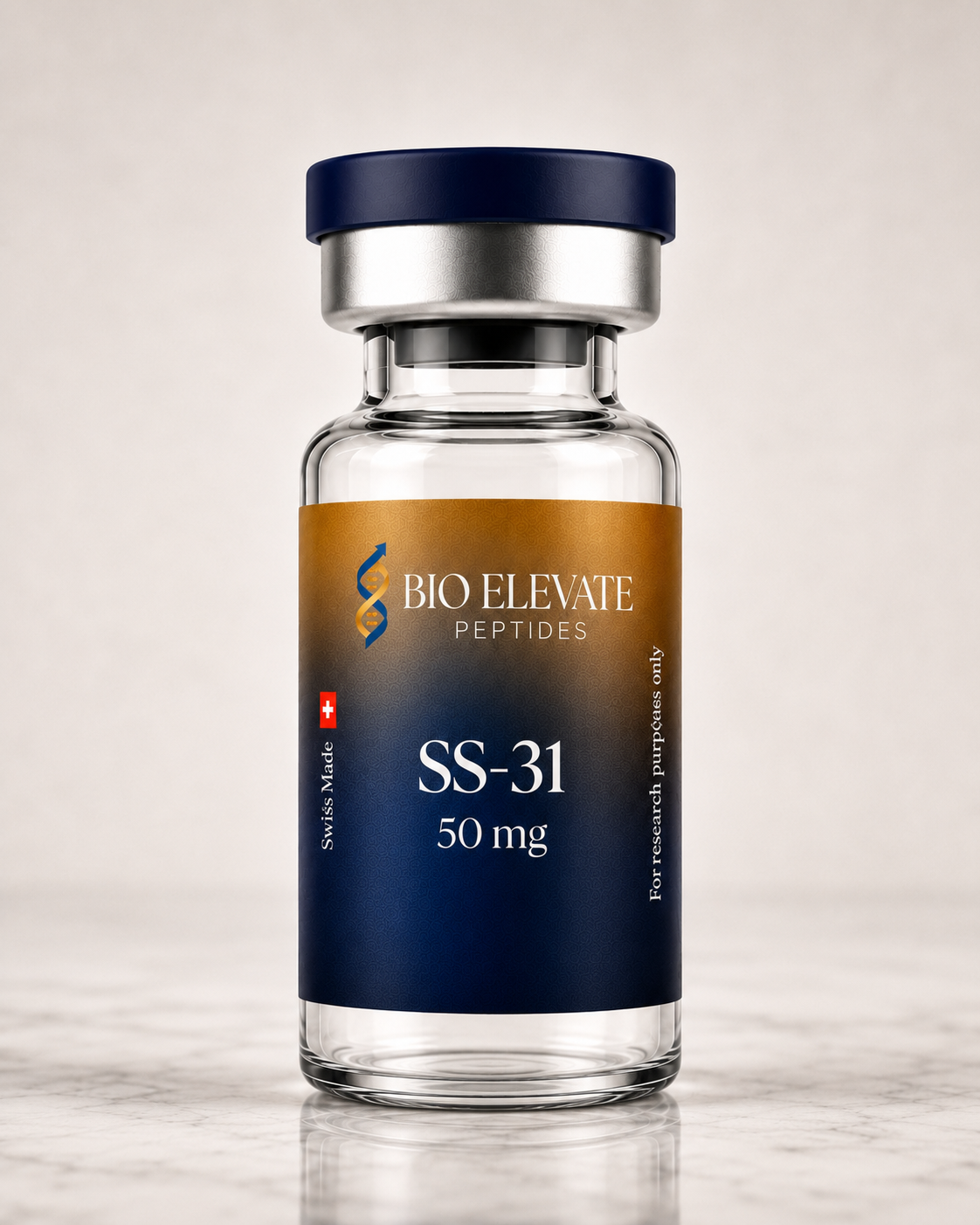
SS-31 | 50mg Research Grade · Swiss Manufactured · Lyophilized
Overview
SS-31 (also designated Elamipretide, MTP-131, or Bendavia) is a synthetic, cell-permeable, mitochondria-targeting tetrapeptide developed by Drs. Hazel Szeto and Peter Schiller at Weill Cornell Medical College — from whose surnames the “SS” nomenclature derives. Composed of alternating aromatic and cationic residues in the sequence D-Arg-Dmt-Lys-Phe-NH₂, SS-31 represents the most advanced and extensively validated member of the Szeto-Schiller (SS) peptide family of mitochondria-targeted antioxidants. Its defining molecular innovation is its selective, high-affinity interaction with cardiolipin — a unique phospholipid exclusively expressed in the inner mitochondrial membrane — which drives its spontaneous and concentration-independent accumulation within mitochondria, independent of membrane potential. This mechanism of action distinguishes SS-31 from all other mitochondria-targeted compounds and has established it as the gold standard research tool for mitochondrial biology, with one of the most rapidly expanding preclinical and translational research profiles of any peptide currently under active investigation.
Sequence
D-Arg-Dmt-Lys-Phe-NH₂ (Dmt = 2′,6′-dimethyltyrosine)
Molecular Formula: C₃₂H₄₉N₇O₅ Molecular Weight: 639.79 g/mol CAS Number: 736992-21-5 Appearance: White lyophilized powder Purity: ≥ 99% (HPLC verified)
Structural Design & Key Features
SS-31’s sequence architecture is the product of deliberate rational design, with each residue contributing a specific functional role:
| Residue | Role |
|---|---|
| D-Arg (Position 1) | Cationic charge carrier; enhances cell penetration and aqueous solubility |
| Dmt (Position 2) | 2′,6′-dimethyltyrosine; primary ROS scavenging moiety; enhanced radical quenching vs. native Tyr |
| Lys (Position 3) | Cationic charge carrier; cardiolipin binding affinity contribution |
| Phe-NH₂ (Position 4) | Aromatic stacking; cardiolipin interaction and membrane anchoring |
The alternating aromatic-cationic motif enables amphipathic interaction with the anionic phospholipid cardiolipin, driving selective inner mitochondrial membrane localization without dependence on the electrochemical gradient — a critical advantage over triphenylphosphonium (TPP)-conjugated compounds that lose targeting capacity in depolarized or dysfunctional mitochondria.
Mechanism of Action
SS-31 exerts its biological effects through a precisely defined set of mitochondria-centric mechanisms:
Cardiolipin Interaction & Cristae Preservation
- SS-31 binds selectively and with high affinity to cardiolipin, the signature phospholipid of the inner mitochondrial membrane (IMM), present almost exclusively at cristae membranes
- This interaction stabilizes cardiolipin’s association with cytochrome c, preventing its peroxidation and release — a pivotal early step in both mitochondrial dysfunction and apoptotic cascade initiation
- Cardiolipin binding preserves cristae architecture — the highly folded IMM structure critical to ATP synthase supercomplex organization and maximal oxidative phosphorylation efficiency
Electron Transport Chain (ETC) Optimization
- By stabilizing cardiolipin-dependent respiratory supercomplex assembly (Complexes I, III, and IV), SS-31 restores electron flux efficiency through the ETC
- This reduces electron leak at Complexes I and III — the primary source of mitochondrial superoxide generation — directly attenuating ROS production at its origin rather than downstream
- Net effect: enhanced ATP synthesis efficiency concurrent with reduced oxidative byproduct generation
ROS Scavenging & Antioxidant Activity
- The Dmt residue functions as a potent free radical scavenger, neutralizing superoxide, hydroxyl radicals, and peroxynitrite directly within the mitochondrial matrix
- This dual mechanism — upstream ROS prevention via ETC optimization AND direct radical scavenging — provides a comprehensive antioxidant effect unachievable by conventional antioxidants that act through only one pathway
Mitochondrial Membrane Potential Restoration
- In models of mitochondrial dysfunction, SS-31 consistently restores ΔΨm (mitochondrial membrane potential), a fundamental indicator of mitochondrial health and bioenergetic capacity
- Membrane potential-independent uptake ensures SS-31 reaches and acts upon already-depolarized mitochondria — a critical capability for studying advanced dysfunction states
Apoptosis & mPTP Modulation
- By preventing cardiolipin peroxidation and cytochrome c release, SS-31 inhibits the intrinsic apoptotic pathway at its mitochondrial initiation point
- Modulation of the mitochondrial permeability transition pore (mPTP) — a key mediator of ischemia-reperfusion injury and necrotic cell death — has been demonstrated across multiple model systems
Research Applications
SS-31’s mechanism of action at the core of cellular energy metabolism positions it as a uniquely versatile research tool across virtually every disease domain where mitochondrial dysfunction plays a pathophysiological role:
Cardiovascular Research
- The most extensively studied application — ischemia-reperfusion (I/R) injury models across cardiac, renal, and cerebral tissue
- Heart failure models — preserved and reduced ejection fraction (HFpEF / HFrEF), cardiomyocyte bioenergetics, and myocardial remodeling
- Cardiac aging models — age-related decline in mitochondrial respiratory capacity and ATP production
- Diastolic dysfunction and myocardial stiffness research via titin oxidation pathway studies
Neurodegenerative Disease Research
- Alzheimer’s disease models — amyloid-β induced mitochondrial dysfunction, synaptic energy failure, and neuronal bioenergetics
- Parkinson’s disease models — dopaminergic neuron mitochondrial dysfunction, Complex I inhibition models (rotenone, MPTP)
- ALS models — motor neuron mitochondrial pathology and axonal energy depletion research
- Traumatic brain injury (TBI) — secondary mitochondrial injury cascade studies
Renal Research
- Acute kidney injury (AKI) models — cisplatin-induced nephrotoxicity, contrast-induced nephropathy
- Chronic kidney disease — tubular cell mitochondrial dysfunction and fibrosis pathway studies
- Renal ischemia-reperfusion injury and transplant preservation models
Metabolic Disease & Obesity Research
- Skeletal muscle mitochondrial dysfunction in insulin resistance and type 2 diabetes models
- Non-alcoholic fatty liver disease (NAFLD/NASH) — hepatocyte mitochondrial dysfunction and lipotoxicity
- Mitochondrial biogenesis and dynamics (fission/fusion) in metabolic syndrome models
Aging & Longevity Biology
- Mitochondrial theory of aging — ROS accumulation, mtDNA mutation, and bioenergetic decline
- Sarcopenia research — age-related skeletal muscle mitochondrial dysfunction and atrophy
- Healthspan and functional capacity preservation in aged animal models
- Mitochondrial dynamics — DRP1/MFN1/MFN2-mediated fission and fusion pathway studies
Skeletal Muscle Research
- Muscular dystrophy models — Duchenne MD mitochondrial pathology
- Exercise-induced mitochondrial adaptation and recovery studies
- Disuse atrophy and denervation models
Ophthalmological Research
- Retinal ganglion cell mitochondrial dysfunction — glaucoma and optic neuropathy models
- Age-related macular degeneration (AMD) — RPE cell bioenergetic failure research
- Diabetic retinopathy — retinal vascular and neuronal mitochondrial studies
Mitochondrial Disease Research
- Primary mitochondrial disorders — respiratory chain deficiency models
- mtDNA mutation and heteroplasmy studies
- Leigh syndrome and MELAS pathway research
Comparative Profile — Mitochondria-Targeted Compounds
| Property | SS-31 | MitoQ | SkQ1 | NAD+ Precursors |
|---|---|---|---|---|
| Cardiolipin Binding | ⭐⭐⭐⭐⭐ | ❌ | ❌ | ❌ |
| Membrane Potential-Independent Uptake | ✅ | ❌ | ❌ | N/A |
| ETC Supercomplex Stabilization | ⭐⭐⭐⭐⭐ | ❌ | ❌ | ⭐⭐ |
| Direct ROS Scavenging | ⭐⭐⭐⭐⭐ | ⭐⭐⭐⭐ | ⭐⭐⭐⭐ | ❌ |
| Active in Depolarized Mitochondria | ✅ | ❌ | ❌ | ✅ |
| Cardiovascular Research Data | ⭐⭐⭐⭐⭐ | ⭐⭐⭐ | ⭐⭐⭐ | ⭐⭐⭐ |
| Translational Research Profile | ⭐⭐⭐⭐⭐ | ⭐⭐⭐ | ⭐⭐ | ⭐⭐⭐⭐ |
| Research Publication Volume | ⭐⭐⭐⭐⭐ | ⭐⭐⭐⭐ | ⭐⭐⭐ | ⭐⭐⭐⭐ |
Research Heritage & Translational Significance
SS-31 occupies a singular position in the mitochondria-targeted therapeutics research space:
- Developed through rational peptide design by Szeto and Schiller, with the original research framework published across high-impact journals including the Journal of Pharmacology and Experimental Therapeutics, the Journal of the American College of Cardiology, and Nature Medicine
- Has progressed to Phase II clinical trials under the designation Elamipretide (MTP-131) for conditions including heart failure with preserved ejection fraction (HFPEF), Barth syndrome, and primary mitochondrial myopathy — one of very few peptides with this level of translational advancement
- Preclinical efficacy demonstrated across cardiac, renal, neurological, skeletal muscle, and metabolic disease models, representing an unusually broad translational profile
- The cardiolipin-targeting mechanism is now considered a foundational paradigm in the field of mitochondrial pharmacology, with SS-31 as its definitive research tool
Quality & Manufacturing
BioElevate SS-31 is synthesized in our Swiss GMP-compliant facility using solid-phase peptide synthesis (SPPS) with Fmoc chemistry, incorporating the critical D-arginine stereochemistry at position 1 and the non-standard Dmt (2′,6′-dimethyltyrosine) residue at position 2 under stringent synthetic control. The structural precision of these non-standard residues is verified at every stage of synthesis and quality control. Every batch undergoes comprehensive independent verification:
- Reverse-phase HPLC — purity ≥ 99% confirmed
- High-resolution mass spectrometry (HRMS) — full molecular weight and sequence integrity confirmation
- Chiral purity analysis — D-arginine stereochemical integrity verification
- Non-standard residue verification — Dmt incorporation and integrity confirmation
- Endotoxin testing — LAL method, endotoxin-free certification
- Sterility testing — USP <71> compliant
- Amino acid analysis (AAA) — compositional sequence verification
- Certificate of Analysis (CoA) — issued per batch, available upon request
Supplied As
- 50mg lyophilized powder per vial
- Sealed under inert nitrogen atmosphere to prevent oxidation
- Recommended storage: −20°C, protected from light and moisture
- Shelf life: 24 months (lyophilized); 30 days (reconstituted at 4°C)
- Larger format vial designed to support extended research protocols and multi-experiment longitudinal studies
Reconstitution
Reconstitute with sterile bacteriostatic water or sterile saline. For the 50mg vial, introduce solvent slowly along the inner vial wall in incremental additions, gently swirling between each addition until the lyophilized cake is fully dissolved. Do not vortex or shake vigorously. SS-31 demonstrates excellent aqueous solubility. Allow the vial to equilibrate to room temperature prior to use. Once reconstituted, store at 4°C and use within 30 days. Aliquoting into smaller working volumes prior to refrigerated storage is strongly recommended to eliminate repeated freeze-thaw exposure and preserve peptide integrity across extended experimental timelines.
⚠️ For Research Use Only. This product is intended solely for in vitro and laboratory research purposes. Not for human or veterinary use. Not for consumption. BioElevate products are sold exclusively to licensed research institutions and qualified professionals.
Reviews
There are no reviews yet.